

I tried (almost) everything … so hopefully you don’t have to!

As an Amazon Associate, I earn from qualifying purchases, but using my links doesn’t affect the price you pay. And if you use them or visit my Amazon Storefront, thank you for showing your appreciation for this article!
Looking back, I should’ve recognized the signs much earlier. In fact, how could I have missed them?
I started noticing that in the afternoon, on the drive to school to pick up my kids, my contacts felt like they were sticking to my eyelids. I don’t know what I attributed that to (maybe just not drinking enough boring old water), but I just pretty much ignored it.
It wasn’t until the spring of 2019 that I realized something was really wrong.
I had been a guest on a webinar, and when the replay came out, I actually watched it. (I wasn’t usually one to relive the horror of seeing me on camera.)
I was shocked at what I saw: I seemed to be blinking nonstop. And not just normal blinking, but heavy, forceful blinking. I hadn’t really noticed it until then. And once I noticed, it was all I could think about.
Then, of course, COVID hit … and my eyes got hit with a double whammy. It was near-impossible to get into the eye doctor, and the shutdown meant I was conducting almost all of my meetings over Zoom. That, combined with the high levels of computer work I was already doing, meant things felt like they got worse, fast.
The dry eyes really messed with me. I became super self-conscious when talking with others. I could hardly focus on conversations because I was so worried about what I must look like with the blinking. I’d wait for someone to look away so I could blink, blink, BLINK.
It was literally all I could think about, and the feeling that people were staring or judging was agonizing. (Yes, I realize I was making things worse in my own mind and that most people probably didn’t give it a second though, but it’s how I felt.)
So I took action.
Disclaimer: I am not a certified health expert and my experience shouldn’t be taken as medical advice. All my knowledge in this story comes from my own research, self-experimentation and personal experience, and my situation is different from yours. Please contact your own doctor for treatment for your particular case before trying any of these strategies or supplements.
Visiting the Eye Doctor
I finally got to the eye doctor who, no surprise, told me that I was suffering from dry eye — my distaste for plain water and my computer work were definitely not helping things.
They sent me off with a prescription for steroid drops, some regular eyedrops, a Bruder mask, and some followup care, and the next 4+ years have been filled with trial and error — some successes, but mostly failures.
I also, of course, made an appointment with my primary care doctor to rule out Sjogren’s and any other physiological factor that might be contributing to my symptoms. (Luckily, those tests came back negative.)
I’ve tried a lot of things. And if you’re suffering like I have, then you’re probably trying a lot of things, too.
In no particular order, here’s what I’ve tried, what I’ve liked, what I’ll never do again, and what seems to have worked. I will say that my case seems to be extreme in that many of these products have had little effect on me, but I know they’ve worked well for others. As I mentioned above, your mileage may vary with any of these treatments, and definitely talk with your doctor about your situation before trying anything new. This is just my experience.
Antibiotics and Steroids
The doctors put me on doxycycline for a while as well as steroid eye drops (loteprednol), with no change.
Eye Drops and Gels
I feel like I’ve tried just about every eye drop and gel invented … both prescription and over-the-counter. I really thought the prescription ones would change everything, but they changed nothing.
- Oasis Tears Plus and Systane — the eye doctor recommended preservative-free drops, but I found nearly all the drops gave me no more than a minute’s relief (quite literally).
- Retaine — this felt like the next step up in terms of drops, but again, they gave little to no relief.
- Restasis and Xiidra — I was lucky that insurance covered both for me, but neither provided any relief … and I used them both for long periods of time (they take several months to really become effective).
- Tyrvaya — yep, I even tried the nose spray that was supposed to treat dry eye. Again, it didn’t help me. But I can vouch for the side effect that it’s going to make you sneeze like crazy each time you do it.
- Optimel — you know the saying “hurts so good”? Well, these eyedrops sting like a [insert expletive here], but they provided the longest-lasting relief for me (which still wasn’t that long). When I first ordered this off Amazon, it shipped from England, but it was worth the wait. If you have a decent pain threshold, this might be worth a try.
- Siccaforte gel — If you don’t want the pain of Optimel, this would be a good alternative. It’s a gel and a little awkward to get in the eye, but it offers longer-lasting comfort. Although once you put it in, your eyesight is a little fuzzy for a while. So I’d recommend it right before bed or when you’re going to do your eye mask.
Lid Scrubs
While the eye doctor originally suggested just using some baby shampoo routinely on my eyelids to make sure they were clean (dirty eyelids can end up clogging the Meibomian glands, resulting in dry eyes), mine needed a little more OOMPH. I stopped wearing mascara mostly, but I also knew I had to pay more attention to the eyelids. And so I tried …
- Hypochlor — I mean, it is what it is. Just a lid scrub. It wasn’t providing any immediate relief but I felt like I was doing something.
- We Love Eyes cleansing oil — I will say, I love the freshness of tea tree oil, but I didn’t love that I had to use another product after this to wipe of the oil. I would probably get this again, because it did feel soothing. But results-wise, all of these are the same.
- OCuSOFT Moistened pads — Again, these were fine, but I hated the wastefulness. I usually cut these pads in half or thirds to make them last longer. I wouldn’t use these again only because of the waste.
- OCuSOFT foaming lid scrub — Out of all of these, I like this one best. Less waste. Not as liquidy/drippy as the Hypochlor, and probably just as effective. (Actually placing an order for this now!)
- We Love Eyes eyelid brush — I can’t vouch for this yet, but I’m ordering this now. Hoping it will get in the cracks and crevices better than my washcloth has. (Update: It’s cute, but super-small and probably not worth the investment. I suppose it’s effective, but I think my washcloth or maybe a clean mascara brush does just as good of a job.)
Supplements
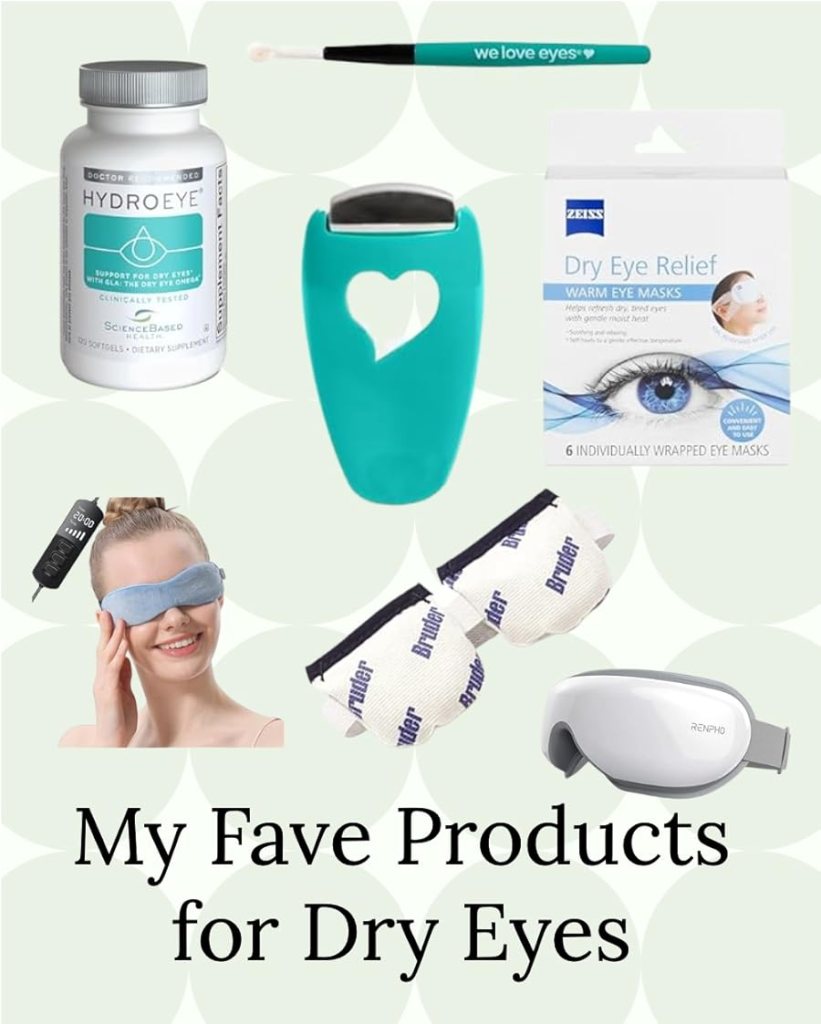
The doctor suggested I start taking supplements to support my eye health. I tried a few eye-specific ones but have moved on to just regular fish oil supplements, which seem to be working just as well as these “eye-specific” ones. Nothing good, bad, or indifferent to report here, so you might give one a try.
In-Office Treatments
Please note that lots of people have great results with these treatments … I just wasn’t one of them (with one exception). They can be expensive and weren’t covered by my insurance, but I was willing to try anything!
- LipiFlow — This treatment was a little creepy, and if you’re squeamish about having things in your eyes, this might not be the treatment for you. But overall, it was relaxing … just not effective for me. Essentially, it just warms up and squeezes out the hardened oil from your glands. I felt great initially after the appointment, but the good feeling didn’t last long and I was back to my dry eyes by the days’ end.
- Blephex — I went through two separate rounds of this, a few years apart. It was fine, but it felt a little nerve-wracking to have someone with a vibrating/spinning tool that close to my eye. It tickled but wasn’t painful. It also wasn’t super helpful in my case.
- MiBo Thermoflow. This, again, felt great as it warmed and lightly massaged my eyelids. But unfortunately, the results were far too temporary. Womp womp.
- Tear duct plugs. Next up, tear duct plugs. I ended up doing only the lowers with permanent plugs (my eye doctor said the uppers would probably make only a tiny difference). I was optimistic this would be immediately noticeable. But once again, no better, no worse.
- IPL laser. This was my most recent foray into non-covered dry eye treatments. Of all the treatments, this is the only one that hurt, but only a little. I had (I think) three or four sessions, spaced a few weeks apart. While the improvements were slight, this was the first treatment where I felt things were getting better. So for me, this was the winner.
At-Home Treatments
Now, these are some of my favorites. I don’t know if they’re always helping, but boy do they feel good!
- Bruder mask. I do love this mask, and I should use it more. I love it because I do feel it helps gets the oils moving again, but I hate it because it just doesn’t stay warm for long, so relief is short-lived.
- Heated mask. Now THIS is my absolute favorite thing. I use it nightly and it feels so good. I love that it has an auto-shutoff and multiple heat settings. It’s not moist heat like the Bruder, but it feels amazing (and super-relaxing). It comes with me on vacation, and I’ve been known to fall asleep with it on quite regularly.
- Renpho massage/heat mask. Another spectacular purchase. The combination heat, massage, compression, and Bluetooth features are another nap-inducing piece of tech. The music it plays isn’t the best, and I haven’t tried the Bluetooth feature to play my own music, but no worries. It’s a great reason to sit and relax.
- Manual eye massage. I’ve tried to do some research on hands-on massage with my fingertips or with blink exercises, but I tend to forget to do them, so …
- We Love Eyes eye roller. I got this cute little thing for Christmas last year. The metal roller ball means it feels really nice when warmed slightly and used on the eyelids, but I’ll admit the eye masks are easier, more relaxing, and more effective.
Other Strategies and Observations
Here are some things that fall into that “other” category — some of which I’ve tried, and some I’m holding as a future last resort.
Chrome Extensions
Beyond these, I’ve tried different Google Chrome extensions to remind me to blink — most of which just annoy me with their frequency. (Which I guess is the point.) If that’s something you’d like to try, check out the Blink Alert Chrome extension, which you can set to remind you to do blinking exercises at set intervals to help reduce eye strain.
Blue Light Glasses
Some studies have indicated that wearing blue light glasses may help reduce eye strain, while I’ve read more recent articles suggesting that it’s not the blue light that’s the problem. Instead, it’s just the strain that comes from staring at a screen and not blinking enough, leading to computer version syndrome. While blue light glasses won’t hurt, they might not help, either.
Too Much Computer Time = More Blinking
I’ve noticed that too much computer work makes the blinking worse (and it’s also what got me into trouble in the first place).
Stress Makes Things Worse, Too
I’ve also noticed that stress makes things worse, too. If I find myself anxious about something or hit with a big deadline, the blinking gets worse. (Could there be an anxiety component to the blinking? Maybe.) Good luck eliminating that daily stress, though, right? But being aware that stressful situations makes things worse and taking some time to decompress (if only for a few minutes) can help.
Blinking Exercises Actually Exist!
Now, while I’m not the best at actually doing regular exercises, maybe I’ll be better at blinking exercises. There are three that I try to go regularly:
- Following the 20–20–20 rule. For every 20 minutes of computer work, I stare at something 20 feet away for 20 seconds. This gives my eyes to focus on something far away instead of on screen.
- Blind computer work. You know, I didn’t even know this was a legitimate exercise until I researched it just now. Sometimes (like right now) I’ll close my eyes and just type blind for a few minutes. I can correct any mistakes later. Giving the eyes a rest can feel really good. And you’re still being productive.
- Actual blinking exercises. You can also change the way you blink — taking slower, more intentional blinks and also squeezing harder with some blinks to stimulate oil flow.
More Glasses, Less Contacts
I hate wearing my glasses, but I’ve been trying to give my eyes a break from contacts when I can. I’m also learning that the kind of contacts I have may change my dry eye experience.
My eye doctor did offer up scleral lenses as an option, but I haven’t tried them. Despite being a lifelong contact lens user, the big ole’ scleral lenses freaked me out a little (I have recurring dreams about trying to put a giant contact in my eyes, much like these lenses). They’re also fairly expensive, if I remember correctly, but one of my main concerns was losing/scratching one and not having a backup. I never have to worry about that with my disposables.
What I’m Doing Now to Manage Symptoms
Because computer work and stress are part of life (although I try to minimize them), I know I can’t eliminate those. But here is what I am going to keep doing:
- Drinking water. It seems obvious, but maybe it’s the obvious things that are sometimes most effective. Luckily, this is also super cost-effective. So grab a big cup or water bottle and sip along with me.
- Take fish oil supplements. I’ve invested in a big bottle from CVS and have it on my bathroom counter to remind me to take it. Bonus: It’s supposed to help with heart health, too, so that’s a win-win!
- Use my heated mask nightly. This is probably the easiest of my tasks because it truly is the most relaxing part of my day.
- Increase my blinking exercises. Setting reminders for this will be key.
- Increase my use of the Bruder mask. The relief is short-lived, but there’s something about the moist heat that seems incredibly effective.
- Keep my eyes out (no pun intended) for another solution to bring relief. It seems like there are new solutions and treatments coming on the market often — some simple, some technologically advanced. Maybe “the fix” is right around the corner.
- Setting me and my computer up for success. The way I use my computer may play an important role in my dry eye, so I want to make sure I keep the screen at arm’s length, increase font size as necessary, and make sure the screen is at an angle where I have to look slightly down at it to work.
So there you have it. My trials and tribulations, hits and misses. If you can learn anything from my experience, it’s to be as proactive as you can you can stop dry eye before it becomes the pain in the you-know-what it’s been for me.
I’d love for you to share your dry eye journey. What’s worked for you? I’d love to try it and report back.

 Four Birds